השוואות דגמים
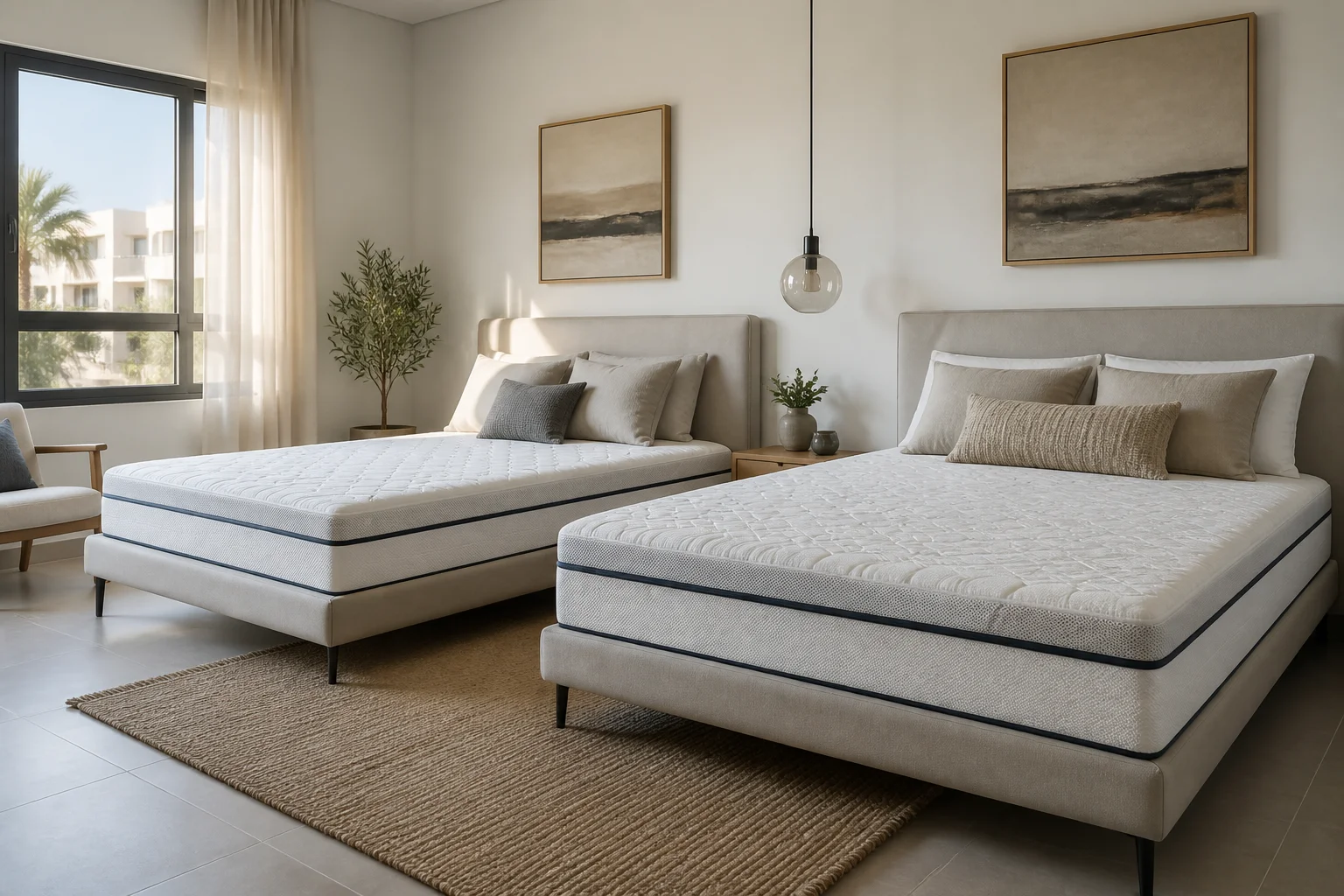
Yoga vs. Turquoise: Which Aminach Mattress is Better for Back Pain

Unsure between Aminach Yoga and Aminach Turquoise due to back pain? In this comparative guide, we will translate the differences in sleep technology, firmness, and support—into a practical decision that suits you.
Why this comparison is important when experiencing back pain
When dealing with back pain, choosing a mattress is not just about "I feel good in the store." What really matters is how the mattress manages spinal alignment throughout the night, how it supports the pelvis and shoulders, and how well it prevents localized sinking or the body "sliding" to the center. The two options you are considering—Aminach Yoga and Turquoise—come with different approaches: one is based on independent springs and an advanced comfort layer, while the other is springless with a latex and polymer core and a natural latex layer.
Our goal here is to translate the differences into the questions you are really asking: what kind of support will you receive, what will happen to the pelvis when you lie on your side, and which model tends to suit those who wake up with a stiff back.
Quick Overview: Yoga vs. Turquoise in One Line
- Aminach Yoga: A mattress with independent springs and a ViscoGel layer—designed for a combination of targeted support, pressure relief, and motion isolation for uninterrupted sleep. See: Aminach Yoga Mattress.
- Aminach Turquoise: A springless mattress with a LATEX and polymer core and a 100% natural latex layer for body adaptation and pressure relief, one-sided with Extra Pillow Top. See: Aminach Turquoise Mattress.
What to Check for Back Pain: The Three Decisive Metrics
1) Spinal Alignment
The mattress should hold the pelvis so it does not “fall” inward, while also not pushing the shoulders/waist outward. When there is an imbalance, you may wake up with strain in the lower back or a feeling of stiffness along the back.
2) Pressure Relief in Shoulder and Pelvis Areas
Especially for side sleeping, the shoulder and pelvis are pressure points. A mattress that reduces pressure allows for controlled sinking in these areas—without losing support in the center of the body.
3) Stability and Motion Isolation
If you sleep as a couple, your partner's movement can cause micro-awakenings. With back pain, this is significant: interrupted sleep worsens the feeling of pain in the morning for many. Therefore, it is worth considering motion isolation and the stability of the support layer.
Aminach Yoga: Who is it Suitable for When Experiencing Back Pain
Aminach Yoga Mattress is built around independent springs and a ViscoGel layer. In practice, this creates a sleep experience that tries to combine “targeted support” with a feeling of softness that reduces pressure.
What Independent Springs Provide for the Back
Independent springs work as separate units. Instead of the mattress behaving as a single surface, each area responds independently. This can help when there are differences between the shoulder area and the pelvis: the shoulder can sink a bit more, while the pelvis receives resistance that helps maintain a stable waist line.
ViscoGel: “Smart” Softness without a Heavy Warm Feeling
Visco (Memory) is known for its ability to wrap and reduce pressure, but sometimes it feels “sinking” or warm. When it comes to ViscoGel, it refers to a comfort layer aimed at pressure relief with a more balanced feeling. For those with back pain, this can be an advantage if you need softness in the shoulders/pelvis but do not want to feel like you are “sinking in.”
Who Yoga Tends to Suit More
- Side sleepers who need pressure relief in the shoulder and pelvis, while still wanting targeted support.
- Couples looking for motion isolation for more continuous sleep.
- Those who like a “gentle springy” feeling—not a rigid board, but responsiveness that returns support when changing positions.
Aminach Turquoise: Who is it Suitable for When Experiencing Back Pain
Aminach Turquoise Mattress is a springless mattress with a LATEX and polymer core and a 100% natural latex layer, in addition to a one-sided structure with Extra Pillow Top. This is a completely different approach: less “mechanical system” (springs) and more “elastic core” that distributes loads continuously.
Natural Latex: Elastic Support that Reduces Pressure without Deep Sinking
Latex is considered a springy-elastic material: it responds quickly to position changes and provides a continuous feeling of support. For back pain, this can work excellently for those looking for stability with anatomical adaptation—meaning the mattress “fills” the natural curves without allowing for too deep sinking of the pelvis.
Core with Polymers + Comfort Layer: Balance between Base and Lying Feeling
The combination of a latex/polymer core with a natural latex layer and an Extra Pillow Top layer is designed to provide both a supportive base and a more pleasant upper layer. If you are sensitive to pressure in the shoulder area but do not want a springy feeling—Turquoise may be a suitable direction.
Who Turquoise Tends to Suit More
- Those who prefer a springless mattress with a uniform and continuous feeling of support.
- Those who change positions a lot and want quick responsiveness (less “slow memory”).
- Back sleepers looking for a stable base that supports the pelvis and encourages spinal alignment.
Practical Comparison for Back Pain: Firmness, Pelvis/Shoulders, and Motion Isolation
Firmness Level: What You Feel and What It Means for the Back
With back pain, “firmer” is not always better. The goal is supportive firmness: that the pelvis does not sink, but the shoulders are not compressed. In practice:
- Yoga tends to feel like a combination of targeted support (from the springs) with upper softening (ViscoGel). This is suitable for those who need both support and focused softness.
- Turquoise tends to feel stable-elastic, with a “material springiness” of latex and less sinking feeling. This is suitable for those looking for a uniform base without a springy feeling.
Pelvic Support: The Key Point for Lower Back
If the pelvis sinks too much, the lower back enters an unnatural arch. Here the difference is mainly in the mechanism: in Yoga, the independent springs can provide targeted resistance under the pelvis; in Turquoise, the latex-polymer core provides continuous resistance that holds the pelvis evenly. If you feel like you are “falling to the center” in soft mattresses—it is worth emphasizing this feeling during the check.
Shoulders and Side Sleeping: Who Provides More “Pressure Relief”
For side sleepers, a shoulder that cannot sink enough will cause a tendency of the neck/upper back. In Yoga, the ViscoGel layer can provide pleasant softening in the shoulder area. In Turquoise, latex knows how to reduce pressure while maintaining elasticity—sometimes with a “lighter” feeling and less deep wrapping.
Motion Isolation for Continuous Sleep
Yoga emphasizes motion isolation thanks to the independent springs. In Turquoise, since it is springless, there can also be a good feeling of stability—but the nature of the isolation is different. If you wake up from movements, it is usually easier to feel the difference in a mattress with independent springs designed for that purpose.
With back pain, the suitable mattress is one that keeps the pelvis stable, reduces pressure on the shoulders, and allows you to sleep continuously without “sinking” that takes the spine out of its natural line.
How to Choose Between Them in Practice: 6 Questions You Answer Before Deciding
- How do you sleep most of the night? On your side → you will usually want more pressure relief in the shoulders; on your back → you will usually want more stability for the pelvis.
- Where is the pain felt in the morning? Lower back may indicate sinking in the pelvis; upper back/shoulders may indicate localized pressure.
- Do you like the feeling of springs? If not—Turquoise (springless) may feel more natural.
- Do you sleep as a couple and are sensitive to movement? If so—Yoga has a clear advantage in terms of motion isolation.
- Do you “sink” quickly in soft mattresses? If so—look for a feeling that holds the pelvis. Sometimes latex (Turquoise) may feel more supportive; sometimes independent springs (Yoga) will provide good targeted resistance—it’s personal.
- What feeling do you want when turning over? Quick responsiveness → latex; more noticeable wrapping feeling → ViscoGel.
Common Scenarios: Which Model is Better for Each Type of Sleeper with Back Pain
If you are a side sleeper with pain starting in the shoulder and radiating to the back
It is advisable to look for pressure relief in the shoulders without losing support in the waist. Usually, Aminach Yoga will suit those who prefer a combination of independent springs and a ViscoGel layer that softens pressure points. If you do not like the feeling of springs—check out Aminach Turquoise for its latex that reduces pressure elastically.
If you are a back sleeper with lower back pain in the morning
Here the key is pelvic support and preventing sinking. Many will prefer the uniform base feeling of a springless mattress with latex—meaning Turquoise—especially if you are sensitive to a “hole” in the center. On the other hand, if you like a slightly more “springy” feeling and targeted support, Yoga may feel just right.
If you sleep as a couple and wake up from any movement
Continuous sleep is part of the solution. Here Aminach Yoga stands out due to the motion isolation built into the independent springs. If you still prefer springless, Turquoise can be a stable alternative—but it is recommended to emphasize the level of motion transfer in both models during the check.
A Small Upgrade that Feels Big: Mattress Protector that Maintains the Feel Over Time
Especially when investing in a mattress designed for support and pressure relief, it is important to maintain hygiene and the original lying feel. Aminach Mattress Protector with a liquid-proof PU layer and a 100% cotton top can help keep the mattress safe from stains and moisture—without sacrificing a pleasant touch.
When to Consider Another Model (If Neither “Fits” You Right)
Sometimes the issue is not “Yoga or Turquoise,” but the need for a different structure—for example, a richer comfort layer, or a combination of pocket springs with natural latex. If you feel you need another level of motion isolation and targeted support alongside a natural latex layer, it is worth checking out the Aminach Experience Mattress, which comes with isolated pocket springs and a comfort layer made of 100% natural latex.
Summary: How to Decide Between Yoga and Turquoise for Back Pain
If you are looking for independent springs + ViscoGel to get targeted support, pressure relief, and motion isolation—Aminach Yoga is a natural candidate. If you prefer springless with natural latex for a feeling of elastic, stable, and continuous support—Aminach Turquoise may be more suitable.
We recommend choosing based on your dominant sleeping position, shoulder sensitivity versus the need for pelvic stability, and whether you sleep as a couple and need motion isolation. When you are ready, you can explore the models on the product pages and move towards a choice that feels right for your back—night after night.