בחירת מזרן לפי צורך
Firm or Medium-Soft Mattress for Lower Back Pain? Here's How to Choose Right According to Aminach and King Koil Models

Lower back pain does not always require a mattress that is “as firm as possible.” In this guide, we will explain when firmness supports and when it actually creates strain, and how to translate this into a choice between common Aminach and King Koil models.
Why the question “Firm or Medium-Soft” is not really about firmness
When talking about lower back pain, it's easy to fall into the myth: “You need a firm mattress.” In reality, most people do not need a rock-hard mattress—they need proper spinal alignment throughout the night, along with pressure relief in areas like the pelvis, shoulders, and hips.
Firmness is just the “initial feeling.” What determines whether you wake up with a more relaxed back is a combination of:
- Support – how well the core of the mattress prevents excessive sinking and maintains stability.
- Conforming – how well the upper layers “fill” spaces (for example, in the hips) and distribute pressure.
- Support Zone Distribution – whether there are areas that hold the pelvis more and allow the shoulders to sink slightly.
- Motion Isolation and Edge Support – especially important for couples sleeping and for stability when getting up/sitting.
Therefore, the right question is: What level of support and conforming does my body need so that the pelvis does not sink, but also to avoid pressure that twists the pelvis or “stiffens” the back?
What general sources say about firmness level for lower back pain (without overgeneralizing)
In general reviews of mattresses for lower back pain, the recommendation for the “middle of the scale” comes up repeatedly—not too soft and not too firm. For example, Sleep Sage notes that mattresses rated medium-firm (about 6–7 out of 10) tend to provide optimal support for many suffering from lower back pain.
“Mattresses rated medium-firm (6–7 out of 10) provide optimal support” — Sleep Sage
The practical implication: usually, you are not looking for “the firmest,” but rather a stable mattress with a smart comfort layer that distributes pressure without losing support.
When a firm mattress can help—and when it can harm the lower back
When firmness (or a firm feeling) might be appropriate
A mattress that feels firmer may be suitable if you identify one or more of the following conditions:
- Sinking in the center of the existing mattress (the “hammock” feeling) that tilts the pelvis forward.
- Relatively high body weight, requiring a more stable core to maintain alignment.
- Sleeping on your back with a tendency to sink in the pelvis—here, stability in the center of the mattress is especially important.
When excessive firmness can worsen back sensations
An overly firm mattress can create pressure points and cause the body to “fight” the mattress. This happens especially when:
- You sleep on your side – the shoulder and pelvis need to sink slightly to maintain a straight line in the spine.
- You have prominent hips/shoulders – excessive firmness pushes the hips/shoulder up and creates a twist in the waist.
- You wake up with a feeling of stiffness and not “release” – sometimes this indicates excessive pressure rather than support.
When medium-soft is the right choice (but with clear boundaries)
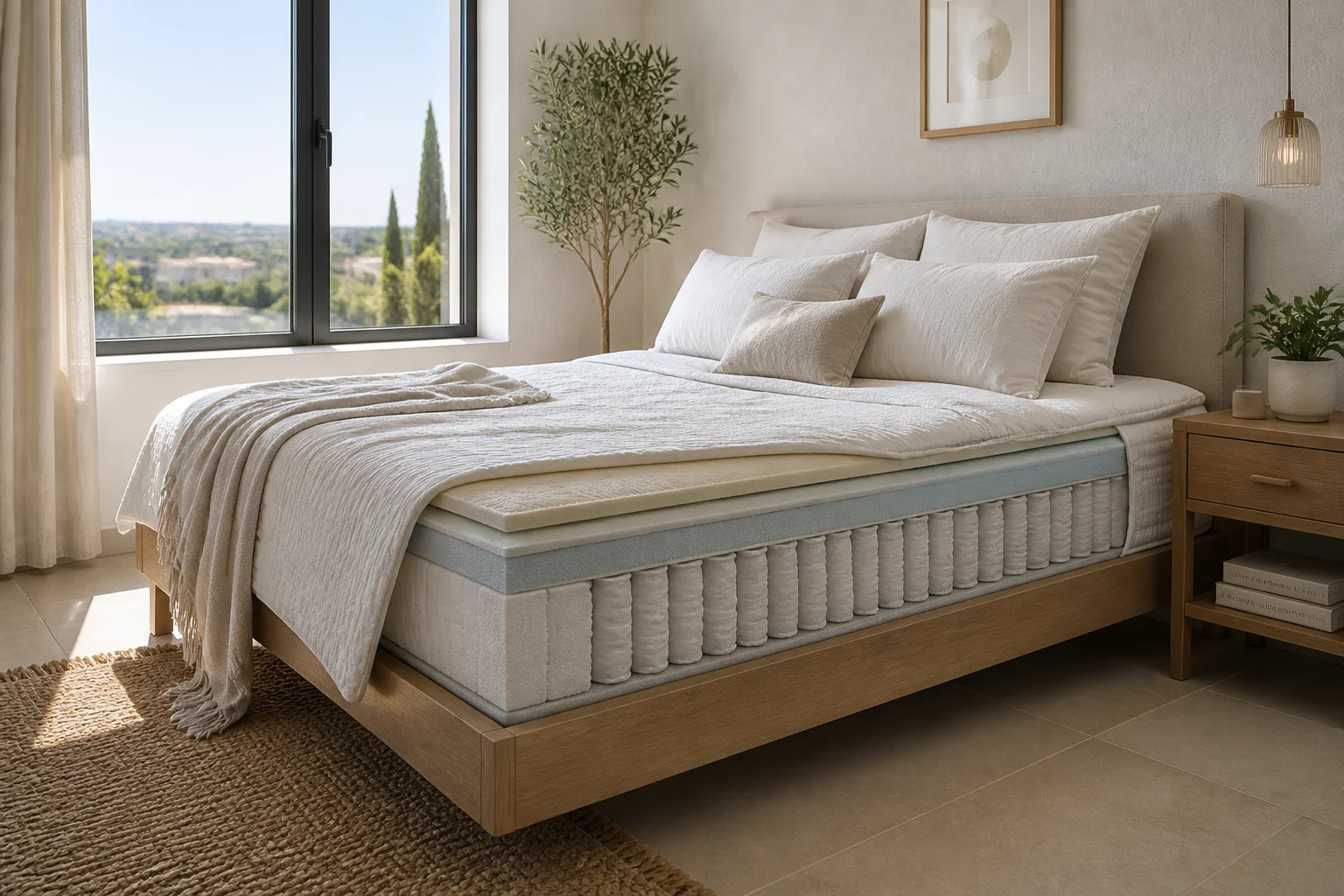
“Medium-soft” is good for lower back pain only if it is not too soft in the core. That is: a plush comfort layer (like Pillow Top/visco/latex) is fine, but beneath it, there must be a support system that prevents sinking.
In practice, this is particularly suitable for two types of buyers:
- Side sleepers looking for pressure relief in the shoulder and pelvis.
- Those who feel “pressed” on firm mattresses and want more body conforming without losing stability.
How to translate this to models: Examples from Aminach and King Koil
To make the decision practical, let’s examine some “archetypes” of mattresses—and link them to common models. The goal is for you to be able to say: “I need central stability + a pressure-relieving comfort layer” or “I need more body conforming without a springy feeling”, and then choose a model accordingly.
1) Want classic balance: stable support + pressure-relieving comfort layer
If you are debating between firm and medium-soft, this is usually the place to start: a mattress that feels “medium-firm” with an upper layer that softens pressure points.
A good example is Aminach Great mattress which comes with One Side System (no need to flip), Grand Pillow Top, and a visco gel layer for pressure relief. This combination tends to suit those who want a feeling of support but do not want the mattress to be “stiff.”
2) Side sleepers wanting more “cuddly softness” without springs
Those sensitive to pressure in the hip/shoulder area may sometimes feel better on a mattress without springs that offers continuous body conforming. Here it is important to note: “without springs” does not mean “too soft”—it all depends on the core and layers.
Example: Aminach Direct mattress—springless, with One Side System, edge support, and natural antibacterial latex (according to the model description). If you want a more enveloping feel while still maintaining stability, this is a direction worth considering.
3) Need strong “point” support and stability in the spine—while still being comfortable
When lower back pain is sometimes related to asymmetrical sinking or movements during the night, a pocket spring system can help due to its point response and motion isolation. Additionally, support zones can improve alignment—especially around the pelvis.
A notable example: Aminach King Koil Joy mattress with a pocket spring system and 7 support zones, 1,333 support points, Sleep Edge, and Grand Pillow Top with Net A (according to the model description). This is especially suitable for those looking for a combination of stability, zoned support distribution, and more stable couple sleeping.
4) Love a stable feel with natural latex and ventilation
Natural latex is often associated with pleasant “springy” elasticity, body conforming, and better ventilation than classic visco layers. For those who feel that heat bothers them at night, or who prefer a “responsive” feel rather than slow sinking—this is an important consideration.
Example: King Koil Aminach Bereshit Sand mattress with a physical spring system, steel frame, Grand Pillow Top layer, and 100% natural latex (according to the model description). This can suit those who want a more stable base along with an elastic comfort layer.
Quick Decision Guide: How to Know Which Side of the Scale You Tend Towards
To choose between “firm” and “medium-soft” in a way that serves the lower back, we recommend going through the following three steps:
- Choose based on primary sleeping position: on your side → you will usually prefer more conforming and pressure relief; on your back → you will usually prefer central stability; on your stomach → you will usually need to be cautious of softness that arches the back.
- Identify the problem with your current mattress: sinking in the center? Pressure in the shoulder/pelvis? Heat? Movements of your partner? Each answer points to a different technology (pocket springs/latex/visco gel/edge support).
- Separate “feel” from “support”: it is possible to choose a mattress with a plush Pillow Top and still have a stable core. This is usually the balanced solution for lower back pain.
Common Mistakes in Choosing a Mattress for Lower Back Pain (and How to Avoid Them)
Mistake 1: Choosing “firm” to avoid sinking—and then discovering pressure points
If you sleep on your side, an overly firm mattress can lift the pelvis/shoulder and cause curvature in the waist. In such a case, it is better to look for a mattress with a pressure-relieving comfort layer above a supportive base—and not to make everything firm.
Mistake 2: Choosing “medium-soft” and forgetting about the core
Medium-soft is good only when it does not break down into a “hammock” feel. If you feel that the pelvis is sinking too much—look for models with advanced spring systems or support center and edge support.
Mistake 3: Ignoring couple sleeping
Lower back pain can sometimes be exacerbated simply because sleep is interrupted—your partner moves, and you are shifting/turning. In such a case, motion isolation (like with pocket springs) and edge support can be a “game changer.”
How We Recommend Finalizing the Choice in Practice
After you have understood whether you tend towards firm or medium-soft, choose a model based on the “sleep engineering” that suits you:
- Looking for balance and support with pressure relief → a direction like Aminach Great (Pillow Top + visco gel).
- Looking for enveloping softness without springs → a direction like Aminach Direct (natural latex, edge support).
- Looking for point support and support zones for couple integration → a direction like King Koil Joy (pocket springs, 7 zones, Sleep Edge).
- Looking for a stable base with natural latex and a responsive feel → a direction like King Koil Bereshit Sand (physical springs + natural latex).
If you want to shorten the path even further, you can also use our comprehensive guide How to Choose a New Mattress Without Regret, and then come back here to focus on firmness and technology according to the lower back.
Summary and Gentle Recommendation for the Future
For lower back pain, the right choice is usually not “firm at all costs” and not “soft and plush,” but rather a balanced mattress: a core that supports and stabilizes the pelvis, and a comfort layer that distributes pressure and allows the spine to remain in a natural line. Now that you have clear terminology (support, body conforming, support zones, latex/visco gel, edge support), it is easier to choose a model that truly suits you.
From here, we recommend reviewing the models we mentioned, comparing them based on your sleeping position and the feel you are looking for, and discovering the collection that suits your back—one step before you decide.