בחירת מזרן לפי צורך
Sleeping on your side and suffering from shoulder pain? Here's how to choose an Aminach mattress

When sleeping on your side, the shoulder must 'sink' into the comfort layer without the back collapsing. In this guide, we will translate this into a practical choice between Aminach models based on feel, support, and motion isolation.
Why Side Sleepers Wake Up with Shoulder Pain
Sleeping on your side is a common position, but it also places very specific demands on the mattress: the shoulder and hip need to sink enough for the spine to remain straight (not 'banana-shaped'), while the body needs to receive targeted support to avoid collapsing in the center.
When either of these things doesn't happen, we often feel it first in the shoulders: pinpoint pressure on the shoulder joint, numbness in the arm, or small awakenings due to discomfort. Therefore, when choosing a mattress for side sleepers with shoulder pain, we are not looking for the 'hardest' or 'softest', but rather a precise balance between controlled sinking and support.
Two Principles to Check: Shoulder Sinking and Spinal Alignment
1) Shoulder Sinking (Pressure Relief) without Feeling 'Stuck'
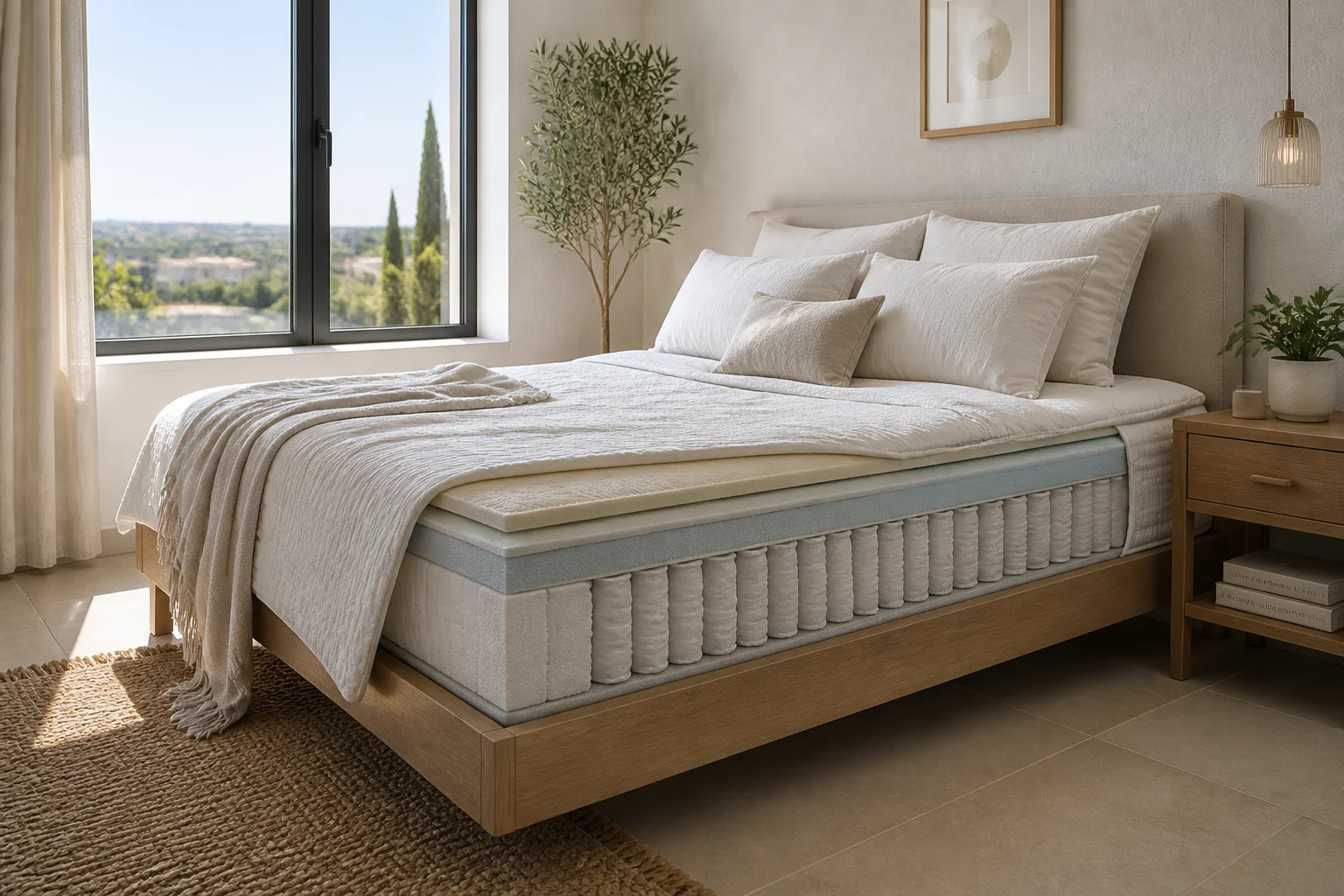
In a good mattress for side sleepers, the top comfort layer allows the shoulder to sink slightly to reduce pressure. Here, materials like visco/visco-gel or latex come into play, as well as Pillow Top layers that add initial softness.
However, 'empty' softness (too deep sinking without support) can cause the shoulder to sink, but also pull the back and neck into an unbalanced position. Therefore, we always look for softness that has backing from a stable core.
2) Spinal Alignment through Targeted Support
When sitting on the side, the hip is usually heavier than the shoulder. If the mattress doesn't know how to provide targeted support, the hip 'sinks' in, the waist bends, and the shoulder compensates—which can worsen the feeling of strain.
This is where technologies like isolated pocket springs and support zones have an advantage: they allow the mattress to respond differently to the shoulder and hip, instead of behaving like a uniform surface.
How to Translate This into Specifications: What to Look for in an Aminach Mattress for Side Sleepers
To choose correctly, we will use a short 'checklist' that connects your morning feeling to the features in the mattress.
- Pressure-relieving comfort layer: Visco/visco-gel or natural latex can help reduce pressure points in the shoulder.
- Isolated pocket springs: Provide targeted support and also help with motion isolation during couple sleeping.
- Support zones (e.g., 5/7 zones): Designed to provide different support for shoulder/waist/hip—especially significant for side sleepers.
- Edge support: If you tend to sleep close to the edges or turn a lot, edge support stabilizes and reduces 'falling' out.
- One Side System: For those who prefer simple maintenance without flipping the mattress (not directly related to the shoulder, but related to long-term usability).
Recommendations by Aminach Models: Who is Suitable for Side Sleepers with Shoulder Pain
Here we organize several relevant models from the catalog, according to the important criteria for side sleepers: lying feel, targeted support, and pressure relief in the shoulder area. The right choice also depends on weight, preference for softness/hardness, and whether you sleep alone or as a couple.
Aminach Topic – For Those Seeking the 'Right' Softness for the Shoulder with Regional Support
Aminach Mattress Model Topic combines Extra Pillow Top and a layer of 100% natural latex, along with isolated pocket springs and 5 support zones.
For side sleepers with shoulder pain, this combination usually works well when you want a more luxurious feel on top (so the shoulder doesn't stay 'on the surface'), but it's still important that the hip doesn't sink too much thanks to the regional support.
Who it’s especially suitable for: Those who feel pressure in the shoulder on a mattress that is too hard and prefer an elastic-supportive feel (latex) rather than a very 'slow sink'.
Aminach Experience – For Those Who Value Motion Isolation and Precise Targeted Support
Aminach Mattress Model Experience is described as an orthopedic mattress with isolated pocket springs and a rich comfort layer made of 100% natural latex, emphasizing targeted support and motion isolation.
If you sleep on your side, especially as a couple, motion isolation is not a 'luxury'—it can be the difference between continuous sleep and micro-awakenings that accumulate into fatigue and a feeling of body pain. Isolated pocket springs tend to help with this, and also allow for finer adjustment in the shoulder area.
Who it’s especially suitable for: Couples, or those who wake easily from movements; those who want a balanced feel with responsiveness (latex) and targeted support.
Aminach Master – For Those Who Need 'Soft-Cool' Pressure Relief with Simple Maintenance
Aminach Mattress Model Master includes One Side System (no need to flip), visco-gel layer for pressure relief, and Pillow Top.
Visco-gel is often chosen when looking for a feel that envelops and distributes pressure—something that can be very relevant for a sensitive shoulder. The advantage for side sleepers is that the top layer can 'receive' the shoulder gently, while the core is supposed to maintain overall stability.
Who it’s especially suitable for: Those who prefer a more enveloping feel (visco/g gel), and those who appreciate a one-sided mattress for easy operation.
Aminach Barkan – When You Feel Your Body 'Falling' and Need Higher Stability
Aminach Mattress Model Barkan is described as providing powerful support for the back with an orthopedic core to prevent sinking and a spring system.
How is this related to the shoulders? Sometimes shoulder pain in side sleepers does not come only from pinpoint pressure, but rather from the opposite problem: the mattress is too soft in the center, the hip sinks, and the shoulder 'locks' at an improper angle. In such a case, switching to a more stable model can improve alignment and reduce indirect strain on the shoulder.
Who it’s especially suitable for: Those who feel sinking in the center or lack of stability, relatively heavier individuals, or those who prefer a more supportive feel rather than a soft-luxurious one.
How to Know if the Problem is the Mattress or the Pillow?
For side sleepers, the pillow is an 'extension' of the mattress: even if the mattress allows the shoulder to sink correctly, a pillow that is too low (or too high) will pull the neck and transmit strain to the shoulder.
A practical rule of thumb: when lying on your side, we want a relatively straight line from the nape along the upper back. If the head 'falls' down— the pillow is too low; if the head is pushed up—the pillow is too high.
“This pillow can be a comfortable addition to improve support and comfort during sleep.” — IKEA, KVARNVEN Ergonomic Pillow for Back/Side Sleepers
Weight and Couple Sleeping Considerations: What Changes for Side Sleepers
Weight Differences Between Partners
When there is a weight gap, the heavier partner will cause more sinking on their side. In such a case, mattresses with isolated pocket springs and targeted support can feel more balanced, as each side 'works' more independently.
Motion Isolation
If you turn a lot due to shoulder pain, you are also moving the mattress. Therefore, for side sleepers with frequent awakenings, there is an advantage to models that emphasize motion isolation (usually through isolated pocket springs and comfort layers that soften vibrations).
Ventilation and Warmth Feel
Side sleepers sometimes 'sink' more into the comfort layer and therefore feel warmer, especially with enveloping materials. If you are sensitive to heat, it’s worth paying attention to layers like visco-gel or fabrics/structures that promote ventilation, and choosing a feel that doesn’t 'trap' the body.
Common Mistakes When Choosing a Mattress for Shoulder Pain (and How to Avoid Them)
- Choosing Based on Firmness Alone: 'Firm' does not mean 'supportive for side sleepers'. Sometimes too much firmness actually increases pressure on the shoulder.
- Softness Without Support: A mattress that is too soft may feel nice in the store, but at home can cause the hip to sink and misalignment.
- Ignoring the Pillow: Even an excellent mattress will not compensate for a pillow that places the neck at an improper angle.
- Too Short of a Test: Side sleepers are recommended to lie on their side for a few minutes, let the shoulder 'settle', and check for pinpoint pressure.
A Short Decision Map: Which Aminach Model to Choose Based on Your Feel
To finalize the choice practically, here’s a simple way to map your need to a model:
- If the shoulder presses on a firm mattress and you want elastic softness with support zones: Go for Aminach Topic.
- If you sleep as a couple, are sensitive to movements, and want targeted support with latex: Check out Aminach Experience.
- If you love an enveloping feel and pressure relief in a visco/g gel style, and want one side without flipping: Consider Aminach Master.
- If you feel your body sinking in the center and need more stability (even if the shoulder hurts): It’s worth checking Aminach Barkan.
What to Check Before Purchase: 5 Questions to Clarify
Before you decide, we suggest answering the following questions—these will guide you to the right model without guessing:
- Is the pain in the shoulder pinpoint pressure (feeling 'stabbing/numb') or more general strain that also comes from the upper back?
- Do you wake up due to movements of your partner?
- Do you tend to sleep warm and prefer a more ventilated feel?
- What do you prefer in feel: latex (more elastic and bouncy) or visco/visco-gel (more enveloping and slow)?
- Is there a significant weight gap between you, requiring better targeted support and motion isolation?
When you connect these answers to the criteria we discussed (shoulder sinking + spinal alignment), it becomes easier to choose an Aminach mattress that truly fits side sleepers with sensitive shoulders—and not just a mattress that feels nice for a moment.
If you’d like, you can tell us your weight/height, whether you sleep alone or as a couple, and whether you prefer a more latex-like feel or more visco—and we will help narrow down the relevant models.